
Also found a lot of California Brome among the grasses on the soccer fields at Crissy Field. California Brome has these complex florets that are so flattened they look two-dimensional--beautifully geometric on one side but razor thin when flipped on its edge. It lives only in California, Oregon, and Washington. They look a little like a natural version of the lanyards I made at camp with long plastic strands. The term Bromus refers to the Greek name for oats.
Botanists value this plant because it is a native grass species, grows quickly, and can take over soil from herbaceous weeds. I've seen both green and brown varieties in our region.
22 September 2007
Urban grass preserves

18 September 2007
Confusion in the fields
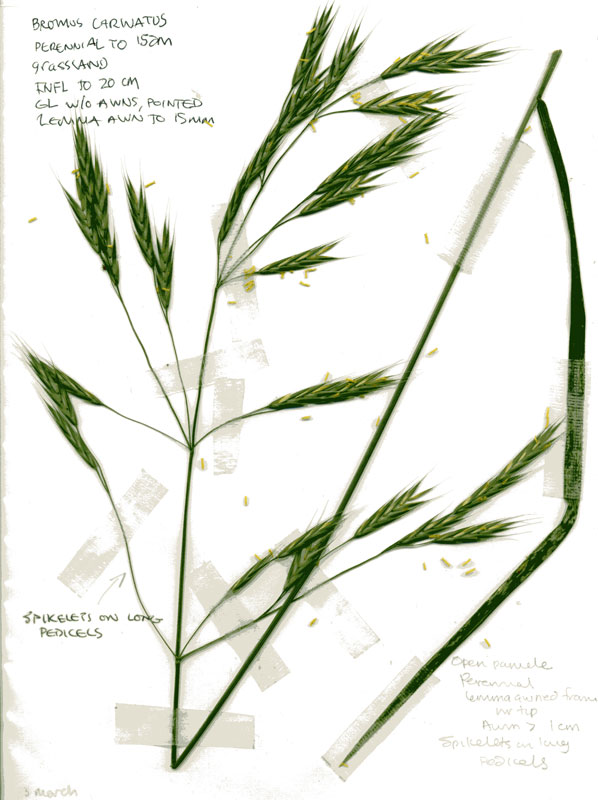 I walked along the eastern end of 16th Street, out near the UCSF campus. It was a delight to realize how many types of grasses can be seen on an hour-long journey. I felt as if I may never be bored again walking in the city.
That said, I feel overwhelmed in my effort to identify the examples I find on my walks. What seems so distinct in the field ends up being hard to identify when I get back to my office.
I did find California Brome or Bromus carinatus, or at least I think I did. According to the great US Dept. of Agriculture website (http://plants.usda.gov/index.html), California Brome is a bunchgrass that is great for erosion control. It is used to rehabilitate landsacpes after mining or wildfires have taken their toll. Livestock and elk don't mind eating this grass and bears and deer can eat it on occasion. At times the seeds are eaten by smaller mammals and game birds, including quail. To my surprise, it is a native plant.
This brome looks far more nasty to the touch than it is--and is actually quite soft.
By the way, the image above comes from an extremely helpful website: "Jasper Ridge Biological Preserve, Stanford University: Some Native and Naturalized Grasses" or http://jrbpgrasses.blogspot.com/. Also helpful for examining local grasses is the pdf "District-Wide Wild Plant Photo Guide" which can be found at http://ebparks.com/stewardship/plants/plants.
I also spent quite a bit of time looking at another species out on 16th Street--but only discovered I was looking at Broadleaf Plantain, Plantago major, which is not in the grass family.